 | ||||
 Unsubscribe | EWN Support | Register | ||||
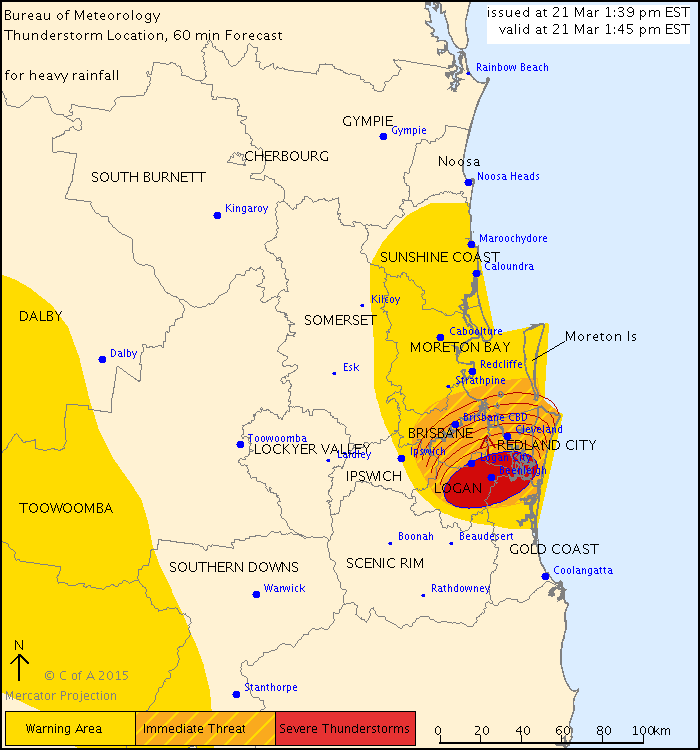
Southeast QLD Severe Thunderstorm Warning: Heavy Rain




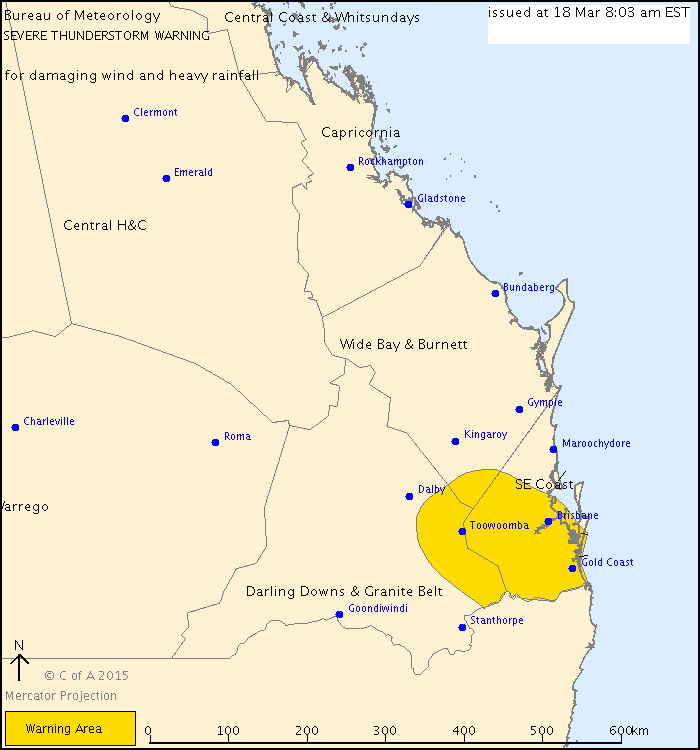
QLD Severe Thunderstorm Warning: Heavy Rain, Damaging Winds
| ||||
| ||||
Unsubscribe | EWN Support | Register | ||||
SCAMwatch email alert: Beware of NBN scams [SEC=UNCLASSIFIED]
17 March 2015: SCAMwatch is warning consumers and businesses to be aware of NBN-related scams seeking to get your personal details or asking you to buy equipment you don't need.
As the rollout of the National Broadband Network (NBN) progresses, you may receive legitimate materials from NBN Co and telecommunications service providers about what you need to do when the NBN comes to your area. Unfortunately, scammers may take advantage of the NBN rollout, using it as an excuse to contact consumers and small businesses. Scammers may call or email with false claims that they need personal details, such as credit card details, to allow access to the NBN. Some scammers may also tell consumers that they need to buy new equipment to use services over the NBN.
Scammers often use major government programs or announcements like the NBN to trick people into handing over their money or personal details. Scammers may pretend to be from NBN Co, a government agency, or a telecommunications provider to sound legitimate. They may spin a range of stories to make their story sound real, such as claiming that personal information such as credit card details is necessary to get access to services over the NBN.
Scammers typically ask for people's financial and other personal details to access their money and commit identity theft.
NBN Co is the company responsible for the NBN rollout. It is a wholesale network provider and does not provide retail services to consumers. It is unlikely that NBN Co will ask consumers for personal bank or credit card details. You should only give your personal bank or credit card details if you know who you are talking to and understand the reason you are providing these details.
If you are unsure about what you need to do to switch to services over the NBN, you should contact your preferred telecommunications service provider using the number in the telephone directory or on their official website.
There are a limited number of circumstances where you may need new equipment when you switch to services over the NBN – for example if you have a household or medical alarm or if you need a new modem or router. Do not purchase any new equipment before speaking with your preferred telecommunications service provider and/or your equipment provider.
Be on guard, you may receive a phone call or email from someone asking for your personal or banking details in order get services over the NBN at your home or business. If you are approached by someone purporting to offer the NBN in this way, hang up and stop contact– the person on the other end may be a scammer. The best approach is to call your preferred telecommunications service provider using the number they list in the telephone directory or on their official website.
How these scams work
- You receive a call, email or knock at the door out of the blue from someone claiming to be from the NBN, a government department or business such as a telecommunications service provider.
- The caller or sender will claim that, because of the NBN, you must provide personal information. You may be asked to provide your bank account details or other personal information.
- If you provide your bank account details or other personal information, the scammer may use it to commit identity theft or to steal your money.
- Alternatively, the caller may tell you that you need to buy new equipment because your existing equipment is incompatible with the NBN and ask you to purchase equipment.
Protect yourself
- Know who you are talking to: If you have any doubts about the identity of any caller who claims to represent a business, organisation or government department, contact the body directly. Don't rely on numbers, email addresses or websites provided by the caller – find them through an independent source such as a phone book or online search.
- Protect your personal information: Never give your personal, credit card or online account details over the phone unless you made the call and the phone number came from a trusted source.
- Think twice before buying: Before purchasing any new equipment for the NBN, make sure you do your own research. Contact your service provider directly and shop around to make sure new equipment is actually required.
- If you think you've been scammed, report it: If you think you have provided your account details to a scammer, contact your bank or financial institution immediately.
Report
You can report scams to the ACCC via the SCAMwatch_report_a_scam_page or by calling 1300 795 995.
More information
Stay one step ahead of scammers, follow @SCAMwatch_gov on Twitter.
You have received this email because you have subscribed to receive SCAMwatch radar alerts on scams targeting Australians. These alerts are issued by the Australian Competition and Consumer Commission and can be viewed on its SCAMwatch website http://www.scamwatch.gov.au.
If you have any doubts about an email's source, verify the sender by independent means - use their official contact details to check the email is legitimate before clicking on links or opening attachments.
If you no longer want to receive SCAMwatch email alerts, please unsubscribe on the SCAMwatch website.
SCAMwatch email alert: Fake rebate scams on the rise
March 2015: In February the ACCC received a spike in contacts about fake rebate schemes so we are warning people to be aware of calls from a fake government department claiming you are owed money.
Scammers have recently been calling Australians offering them a cheque worth $7000 or more claiming to be from the 'Department of Finance' or other government organisation such as the 'Office of State Revenue'. The scammer will demand an upfront payment and various pieces of personal information before the money can be provided. However, there is no money and no connection with any state or commonwealth department.
The scammers may spin a range of stories about why you are owed money to make their story sound real. They might claim that there is money due because of a tax refund, bank fee rebate, one-off payment, investment return or even a bonus. Whatever the story, these scams always involve some government department or organisation claiming you are owed money but you need to pay a fee in order to collect it.
Scammers typically ask for money to be sent via wire transfer as it's nearly impossible to recover money sent this way. They may also ask for people's financial and other personal details to access their money and use this information to commit other scams.
Scammers typically ask for money to be sent via wire transfer as it's nearly impossible to recover money sent this way. They may also ask for people's financial and other personal details to access their money and use this information to commit other scams.
Be on guard – if you receive a phone call from someone saying you are owed money and they then ask you for your personal or banking details or to pay a fee, hang up – the person on the other end may be a scammer. If in doubt, look up the government department or organisation yourself and phone them.
How these scams work
- You receive a call out of the blue from someone claiming to be from a government department.
- The caller or sender will claim that you are owed money for some reason.
- In order to receive the refund/payment you have to pay an administration fee or other fee upfront.
- The caller may tell you that you need to contact their supervisor with a reference number that they provide you in order to make the payment or they might ask you to pay straight away.
- Alternatively, you may be asked to provide your bank account details or other personal information so they can deposit the refund in your account.
- If you send any money via wire transfer, you will never see it again – it's nearly impossible to recover money sent this way. You will also never receive the promised rebate or refund.
- If you provide your bank account details or other personal information, the scammer may use it to commit identity theft or to steal your money.
Protect yourself
- If you receive a phone call or email out of the blue from someone claiming to be from a government department and they claim that you are entitled to money, hang up.
- If you have any doubts about the identity of any caller who claims to represent a business, organisation or government department, contact the body directly. Don't rely on numbers, email addresses or websites provided by the caller – find them through an independent source such as a phone book or online search.
- Never give your personal, credit card or online account details over the phone unless you made the call and the phone number came from a trusted source. If you think you have provided your account details to a scammer, contact your bank or financial institution immediately.
Report
You can report scams to the ACCC via the SCAMwatch report a scam page or by calling 1300 795 995.
If the scammer has posed as a legitimate government department or company, you should also report the incident to them.
More information
Stay one step ahead of scammers, follow @SCAMwatch_gov on Twitter or visit http://twitter.com/SCAMwatch_gov
SCAMwatch email alert: This Valentine’s Day, protect your heart when seeking love online [SEC=UNCLASSIFIED]
February 2015: This Valentine's Day, SCAMwatch is warning the online dating community to beware of any love interest who asks for money.
Signing up to dating websites has proven successful for many singles seeking a match. Unfortunately it has also proven popular among scammers who prey on people's vulnerabilities to steal their money, particularly around sentimental times of the year.
Scammers are experts at preying on people's weaknesses, and will spend months and even years grooming victims to lower their defences. Inevitably, the fraudster will spin a tall tale about why they suddenly need your financial help, ranging from medical emergencies to failed business ventures to needing to rebook flights to visit you.
Once victims realise that their admirer is actually a criminal, the emotional consequences can be devastating.
These scams can also pose a risk to your personal safety as scammers are often part of international criminal networks. Scammers have lured unwitting Australian victims overseas, putting people in dangerous situations that can have tragic consequences.
If you are looking for love online, don't let a scammer leave you broke and with a broken heart. If your online admirer asks for money, ask yourself: 'Do I really know who I'm dealing with?'
How the scam works
- You meet someone online through a dating or social networking website whom you seem to just 'connect' with.
- The person may have an appealing profile, claim to have similar likes and dislikes or have gone through similar experiences.
- Your online admirer will soon ask you to communicate through a private channel such as via email or webcam.
- After trust and a relationship is established, they will ask you for money to help cover costs associated with illness, injury, a family crisis or travel to see them.
- Scammers will often disguise their request for money as a short term loan to help them out until they can get access to some other source of funds.
- Regardless of the approach, the scammer will typically ask you to send them the money via wire transfer.
- If you send them money, they will continue to ask for money to get out of other problems. Amounts requested may initially be small but tend to increase over time.
- If you send money to a scammer – especially via a wire transfer – it is almost certainly gone forever. Just as importantly, your heart may be broken and trust shattered.
Protect yourself
Think twice: Never provide your financial details or send funds to someone you've met online. Scammers particularly seek money orders, wire transfers or international funds transfer as it's rare to recover money sent this way.
Watch out: If an online admirer asks to communicate with you outside the dating website, such as through a private email address or over the phone, be very wary – scammers want you away from any safeguards that are in place on the site.
Search: Use the Google 'search by image' tool to check the authenticity of any photos provided by someone you met online as scammers often use fake photos they find online.
Avoid: Don't share photos or webcam of a private nature. The ACCC has received reports of scammers using this material to blackmail victims.
Report: If you think you have provided your financial details to a scammer, contact your bank or financial institution immediately. If you think you met a scammer through an online dating service, let the site operator know.
Report
You can report scams to the ACCC via the report a scam page on SCAMwatch or by calling 1300 795 995.
More information
In 2014 the ACCC conducted an internet sweep of the online dating industry to review:
- compliance with the ACCC's Dating Industry Best Practice Guidelines, which were published in 2012 following a collaborative effort with online dating service providers as part of an industry working group; and
- whether dating sites are being true and fair in their dealings with customers.
The sweep findings are available in the ACCC online dating industry report.
Stay one step ahead of scammers, follow @SCAMwatch_gov on Twitter or visit http://twitter.com/SCAMwatch_gov.
You have received this email because you have subscribed to receive SCAMwatch radar alerts on scams targeting Australians. These alerts are issued by the Australian Competition and Consumer Commission and can be viewed on its SCAMwatch website http://www.scamwatch.gov.au.
If you have any doubts about an email's source, verify the sender by independent means - use their official contact details to check the email is legitimate before clicking on links or opening attachments.
If you no longer want to receive SCAMwatch email alerts, please unsubscribe on the SCAMwatch website.
RACQ calls for cheaper registration to end fuel price rorts
 |
QUEENSLANDERS are coughing up more to own their car than any other state, according to RACQ, which is now demanding change from Labor and the LNP.
The motoring group has released its "policy manifesto", which called on the next Queensland Government - whoever wins - to bring down the cost of registering the family car.
It is also pushing for the government to crack down on service stations that show a discounted cost of fuel instead of the real price, claiming it undermines industry competition.
The LNP froze registration fees when it took power in 2012, but RACQ executive manager Paul Turner said that the cost was still too high.
"The freeze saved motorists up to $44.40 over the last three years, but we still pay more than motorists in every other state," he said.
"How is it fair that Queenslanders pay $50 more a year to register the same four-cylinder car than Victorians? Or $200 a year more to register a medium car?"
RACQ wants both LNP and Labor to promise a three-year extension to the registration freeze, or to simply bring down the cost.
On service station pricing, RACQ has labelled the tactic of outlets showing off their discount fuel price as "misleading and fraudulent".
"Current fuel price signs outside fuel stations are, more often than not, a rort and cost motorists hundreds of dollars a year," Mr Turner said.
"Most petrol station signs show a highlighted discount price which is not available to many motorists. How can we have genuine competition in the fuel market if the prices on the signs are dependent on having the right voucher or making in-store purchases?"
Mr Turner said other states have address the signage issue and Queensland must follow suit.
Queensland consumers angry over mass mango dumpings in FNQ
 |
| Unsellable mangoes in Far North Queensland. |
It's hard for anyone to imagine beautiful far north Queensland mangoes could be worth nothing.
After all, mangoes are the 'king of fruits', which is why consumers are so willing to pay top dollar for premium product. But what becomes of fruit that doesn't make the grade?
The sad reality this summer is tonnes and tonnes of mangoes have ended up on the scrapheap for no reason other than their appearance.
A loss of juicing contracts and a bumper season in the Mareeba-Dimbulah district resulted in tons of blemished fruit, that won't make the premium grade, being thrown out.
Mango grower Merryl Patane said it is a reflection of the market that thousands of mangoes will end up in a dry gully on their small farm, outside of Mareeba.
"There's nowhere else to put them. We need the cage for tomorrow for more fruit to be dumped," she said.
"It's very sad. Just visual, it's just looks. It's not affecting the flesh whatsoever. Apparently no-one will buy that."
There's nowhere else to put them. It's very sad. Just visual, it's just looks. It's not affecting the flesh whatsoever, apparently no-one will buy that.
The challenge of marketing fruit that does not "meet retail specification" has become more apparent following a steep decline in juicing contracts in recent years.
Australian Mango Industry Association president Robert Gray said it was a combination of less demand for blended juice products and the availability of much cheaper puree imported from countries such as Mexico, Brazil and India.
"Labour's a big component of our cost structure, plus we've got to transport the raw material often thousands of kilometres to where the product's processed. And in the case of mangoes, about half of that product is seed and skin."
"So yeah, we are an expensive producer of puree and we need to make sure we're developing markets for products where the benefits of our mangoes are better aligned with what consumers want."
But judging from the angry reaction by consumers on social media networks to photographs of mangoes destined to be dumped, that's not necessarily so.
Many have questioned why the fruit could not be processed, value-added or, at the very least, donated to charity. But Mr Gray said that is not so easy.
The quick fix would be saying 'look, let's just bundle this fruit up in boxes and send to market', but that's not going to work. You've got to identify the markets, develop the processes to get it to market and then grow those markets.
"A big percentage of this fruit is going through the processing channel because it doesn't have the legs to make it through the (fresh fruit) channel. It may be a little bit overripe or it may have a cut in the surface of the fruit that may cause issues through that channel," he said.
"The market for second grade and third grade through the retail channel this year has seen huge growth and we're continuing to drive that... and provide a value equation for consumers that inspires them to buy our products whether it's through ice-blocks, or frozen cheeks or products that have puree in them that have that unique, Australian flavour.
"It's not any easy job. The quick fix would be saying 'look, let's just bundle this fruit up in boxes and send to market', that's not going to work.
"You've got to identify the markets, develop the processes to get that product to market and then grow those markets."
But still the reality of the fresh fruit and vegetables that will never make it to the supermarket shelf because of its aesthetic shortcomings has struck a chord with many in the public. Many organisations such as OzHarvest's REAP program and Second Bite has emerged from grassroots initiatives aimed at tackling food waste.
A photo posted on social media networks of the Mareeba mangoes destined to be dumped evoked an outpouring of anger and disbelief at the senseless waste of a precious commodity.
Melbourne resident Katy Barfield was one of hundreds of people to respond on Twitter.
"We have so many people that I know who'd want access to that product. People who have children who go to school without anything in their lunchbox, families who are struggling to put food on the table," she tweeted.
"It is a disgrace. It's an absolute market failure when we've got farmers who cannot sell their beautiful, quality products and bring that to market for people who want to purchase it."
So incensed by food waste was Ms Barfield that she established her own business, Spade and Barrow, in Melbourne 18 months to find a market for what she describes as 'perfectly imperfect' produce.
The food system is absolutely broken. It takes exactly the same input costs to grow a wonky carrot as it does to grow a straight one. The farmer gets no compensation for that whatsover.
Katy Bradfield, Spade and Barrow
"I just realised that the food system is absolutely broken. It takes exactly the same input costs to grow a wonky carrot as it does to grow a straight one. The farmer gets no compensation for that whatsover and finds it hard to bring that product to market."
But even as a distributor of fresh food, Katy Barfield conceded she was not in a position to save the mangoes going to waste more than 4,000 kilometres away in Mareeba.
"One of the biggest challenges for us is logistics, actually getting that product to the various states and territories. We try to work as local as possible, so a lot of the farmers we're working with are within 100 kilometres of where we operate," she said.
"It's about collaboration. We're only going to solve these issues together."
Meanwhile, mango growers like Ross and Merryl Patane will work long hours in the oppressive far north Queensland summer, never knowing whether their efforts will be rewarded.
"If you have good quality and you can get it into the chain stores, you'll do okay with price, but there's a lot of fruit out there, so hopefully our quality will get us over the line," said Mrs Patane.
Irish scammers have visas cancelled and kicked out of Australia

A GROUP of alleged scammers will be kicked out of Australia.
Police found more than $120,000 and a treasure trove of expensive jewellery and luxury goods during raids at Hazelmere in Western Australia.
Police and Department of Immigration and Border Protection said 24 Irish nationals were allegedly charging vulnerable aged people massive amounts for roof fixing and other home repair jobs when the work wasn't needed.
The DIBP cancelled 24 visas.
Seven people were arrested and the DIBP detained 19 others in the sting.
"The scam involved convincing vulnerable people to part with substantial amounts of money to fix roofing or other home maintenance issues," Border Protection Assistant Minister Michaelia Cash said.
"The work was then not completed or even required in the first place."
"Those individuals who have had their visas cancelled are now currently in detention while the department makes arrangements for their removal from Australia."
Queensland consumers cash in on refunds thanks to Office of Fair Trading
 |
The Office of Fair Trading (OFT) returned $3.6 million worth of goods and services to consumers in 2014, including cars, air-conditioners, solar panels, caravans and jewellery.
The OFT addressed a total of 14,835 complaints during the year, resulting in $3.681 million worth of refunds for consumers.
"The OFT offers a conciliation service to help resolve disputes between consumers and businesses when issues arise with faulty products or poor service," Executive Director of OFT, Brian Bauer said.
"Queensland businesses generally do the right thing and only a fraction of marketplace transactions ever come to OFT's attention," he said.
"If something does go wrong with a product a consumer has bought, the business has a legal responsibility to put the problem right."
Fair Trading returns $3.6M
Mr Bauer said even if a customer had a bad experience with a product, a willingness to sort out the problem could turn that experience into a positive one.
"Sometimes though, a consumer and business can't resolve a dispute and that's where OFT can help," he said.
When a consumer makes a complaint, the OFT assesses it and, if the information provided suggests the consumer might be entitled to redress, will contact the business on their behalf to attempt to negotiate a solution.
"Although the OFT cannot force a business to give a consumer a refund or replacement, over 92 per cent of cases were satisfactorily resolved in 2014," Mr Bauer said.
The top industries complained about in 2014 were personal and household goods, like furniture, electronics or whitegoods; motor vehicle servicing and repairs; motor vehicle sales; real estate agents; and, personal and household services, such as beauty, cleaning, repair or home maintenance services.
Conman Pastor Steve Jones will have plenty of time in the slammer to pray for the people he ripped off
 |
| Pastor Steve Jones - conman extraordinaire. |
Notorious Gold Coast conman Pastor Steve Jones has this evening been sentenced to three years in prison, but will be eligible for parole within 13 months over a solar power scam which saw him net hundreds of thousands dollars from trusting families.
During today's court appearance, Jones' full criminal history was revealed – dating back to 1978.
As well as fraud, Jones has also committed indecent exposure offences over a period of 20 years, he has also faced multiple theft charges as well as causing malicious injury.
Jones has also been convicted for conducting an unregistered charity and falsifying books, a scam which netted him $21,000.
The pastor was today sentenced for a 2010-11 fraud, which saw him fleece an estimated $400,000 from hundreds of Queensland families who he promised to install solar panels for.
Instead, the conman stole their deposits, pocketing $900 from each customer.
Today his lawyer told the court Pastor Steve was suffering depression and that his indecency offences were a matter of "trying to prove oneself where inadequacy lies."
One woman has detailed her ordeal with Jones to A Current Affair.
Professional carer Maree Putuwai claims she was duped by the fraudster, after responding to a Gumtree advertisement allegedly posted by Jones' mother, looking for someone to care for her son who had been injured in a workplace accident.
Ms Putuwai told A Current Affair, they exchanged a series of emails, where Jones was described as "shy" and needing someone "he could trust."
The carer was told when she came for the job interview, she would be required to wash Jones to see if she could handle a "showering moment with him."
But when that moment came, she was told by Jones to wash him in a specific area.
"I started washing him in the shower and then he was like, 'you've got to get right in… like your head has to be right there," Ms Putuwai recounted.
"He's like 'don't worry, because I can't feel anything.' But I should have been more clever than that."
Ms Putuwai said she became more uncomfortable and left when asked for more massages.
The experience has left her disgusted and embarrassed.
"I don't want to care for anyone because of what happened with me there," she said.
Read more: http://www.9news.com.au/national/2015/02/11/18/43/pastor-steve-jones-sentenced-to-a-maximum-three-years-in-jail-for-solar-panel-scam#FMAkbmVYvKM5uMl4.99
Cabbies acting illegally in refusing short rides
There is one answer for this illegal bastardry by cab drivers: Jump in, refuse to get out. If the driver calls the police, explain politely to the police officer that the driver is breaking the law and ask the police officer to commence legal proceedings against the driver. You will driven to your destination quicker than the driver can say: "You f%$&*@g b+"%h".
The Courier-Mail reports:
 |
| Communify chief Karen Dare, Zana Vasikic from Ashgrove and volunteer driver Rachael Laffey at Bardon. |
Elderly at mercy of cabbies who won’t collect them.
SOME of Brisbane’s taxis are stranding the city’s elderly by refusing to take them on short trips and collect them from suburbs such as The Gap.
Brisbane woman Peta Van Deyl said she saw the effect of a cab refusing a short fare at Brighton recently.
“I saw an elderly couple walking along and I thought it was a bit hot for them to be walking. I dropped something in a friend’s letterbox, came back around the corner and saw that the man had taken a fall and he had a bleeding face and hands,” she said.
“They said they were at a podiatrist’s appointment and they’d called a cab but no-one would come because the fare wasn’t big enough.”
Ms Van Deyl said the man had Parkinson’s, a deep laceration to the back of his hand, and had taken skin off his nose and cheekbone.
“I’m doing occupational therapy as a degree and the people who are likely to call a cab to travel less than a kilometre are the ones who really need it.”
Bardon community organisation Communify transports clients to do their shopping, and chief executive Karen Dare said they had also heard of taxis being unwilling to travel to Brisbane’s westside.
“We have received feedback from clients that taxis don’t like to drive ‘all the way out to The Gap and outer suburbs just to collect someone who wants a lift around the corner’,” she said.
“We also hear that the clients can be waiting up to an hour or more for the taxi to show, which is a major issue when they have a doctor and specialist appointments.”
An 89-year-old resident of The Gap - who didn’t want to be identified - said she used to do her shopping at The Gap until a taxi failed to show up to collect her.
“I rang the taxi phone then I went out the front and I waited and waited. I was there for 45 minutes at least,” she said.
The woman said she had heard from several people that cabs don’t like picking up from The Gap.
Mr Parker said Yellow Cabs also encouraged drivers to work the suburbs and not stick to the city, Fortitude Valley and airport.
“We have a reputation for being very tough on drivers. We’ve gone to a lot of trouble to work with drivers to get them to understand this company has a service culture, and we will not tolerate anybody who brings us into disrepute,” he said.
Mr Parker urged anyone with a similar complaint to come forward.
“They can make a report online, call us, or ring me personally if they wish because I’d like to hear about it,” he said.
Full story:
SCAMwatch email alert: Invoice email scam now targeting Australian businesses [SEC=UNCLASSIFIED]
January 2015: SCAMwatch is warning Australian businesses to beware of an invoice email scam seeking payment re-direction.
The scam involves scammers pretending to be legitimate suppliers advising changes to payment arrangements. It may not be detected until the business is alerted by complaints from suppliers that payments were not received.
SCAMwatch has received reports from Australian businesses that a scam operating in the northern hemisphere has headed down under. Businesses trading overseas – particularly with companies in Asia – are at higher risk of being ripped off by these scams. The United States and Canadian Better Business Bureau and the Internet Crime Complaints Centre (IC3) have both issued warnings about this business compromise scam.
Sound account keeping practices can help guard against falling victim to this scam. Have a clearly defined process for verifying and paying accounts and invoices.
How these scams work
- Scammers hack into vendor and/or supplier email accounts and obtain information such as customer lists, bank details and previous invoices.
- Your business receives an email, supposedly from a vendor, requesting a wire transfer to a new or different bank account.
- The scammers either disguise their email address or create a new address that looks nearly identical. The emails may be spoofed by adding, removing, or subtly changing characters in the email address which makes it difficult to identify the scammer's email from a legitimate address.
- The email may look to be from a genuine supplier and often copy a business's logo and message format. It may also contain links to websites that are convincing fakes of the real company's homepage or links to the real homepage itself.
- The scam email requests a change to usual billing arrangements and asks you to transfer money to a different account, usually by wire transfer.
- The scam may not be detected until the business is alerted by complaints from legitimate suppliers that they have not received payment.
Protect yourself
- Make yours a 'fraud-free' business – effective management procedures can go a long way towards preventing scams. Have a clearly defined process for verifying and paying accounts and invoices.
- Consider a multi-person approval process for transactions over a certain dollar threshold.
- Ensure your staff are aware of this scam and understand how it works so they can identify it, avoid it and report it.
- Double check email addresses - scammers can create a new account which is very close to the real one; if you look closely you can usually spot the fake.
- DO NOT seek verification via email – you may be simply responding to the scammer's email or scammers may have the capacity to intercept the email.
- If you think a request is suspicious, telephone the business to seek verification of the email's authenticity.
- DO NOT call any telephone number listed in the email; instead, use contact details that you already have on file for the business, or that you have sourced independently – for example, from a telephone directory.
- DO NOT pay, give out or clarify any information about your business until you have looked into the matter further.
- Check your IT systems for viruses or malware - always keep your computer security up-to-date with anti-virus and anti-spyware software and a good firewall.
Report
If you've been scammed there are steps you can take to minimise the damage and prevent further loss. Follow this checklist to protect yourself.
You can report scams to the ACCC via the SCAMwatch report a scam page or by calling 1300 795 995.
You should also spread the word to your colleagues.
More information
SCAMwatch has further information about scams targeting businesses.
Stay one step ahead of scammers, follow @SCAMwatch_gov on Twitter or visit http://twitter.com/SCAMwatch_gov
You have received this email because you have subscribed to receive SCAMwatch radar alerts on scams targeting Australians. These alerts are issued by the Australian Competition and Consumer Commission and can be viewed on its SCAMwatch website http://www.scamwatch.gov.au.
If you have any doubts about an email's source, verify the sender by independent means - use their official contact details to check the email is legitimate before clicking on links or opening attachments.
If you no longer want to receive SCAMwatch email alerts, please unsubscribe on the SCAMwatch website.
SCAMwatch email alert: Beware of fake vouchers that end up costing you more [SEC=UNCLASSIFIED]
January 2015: SCAMwatch is urging consumers to be alert to scammers offering fake vouchers in exchange for financial and other personal information.
SCAMwatch continues to get reports from consumers about receiving emails, text messages and coming across social media posts possibly misusing the names and logos of well-known retailers such as Coles, Woolworths, ALDI, IGA, Bunnings and Myer.
Consumers are typically asked to click on a link, to complete a survey or to download a program to receive a free voucher, in some cases for an amount as high as $1 000. As a slight variation on this scam, consumers may be asked to pay a very small amount (sometimes even as low as just $1) to receive a voucher for a substantially higher amount.
Scammers often use such promotions as a disguise to collect credit card or bank account details and other personal information from consumers to access their money and commit identity theft.
Don't be fooled by a fake promotion – verify whether the offer is legitimate by getting in touch with the retailer purportedly offering the voucher using contact details you find independently.
How these scams work
- You receive an email or text message out of the blue, or come across a social media post, claiming that you will receive, or have the chance to win, a voucher from a well-known retailer.
- The email, text message or social media post appears legitimate and may use official logos and trademarks (or their look-a-likes) to lure you into thinking it is the real deal.
- To receive a free voucher, or to enter the draw, you may be asked to click on a link, to complete an online survey or to download a program. Alternatively, you may be prompted to pay a small amount to receive a voucher of significantly higher monetary value.
- Once you click on the link or agree to complete the survey, you will generally be taken to a website that appears legitimate and professional. The website will prompt you to provide your personal information, which may include your phone number, date of birth, address, qualifications and bank account or credit card details.
- In order to create a sense of urgency and to get you to provide your personal information without thinking, the website may claim that there are only few vouchers left, or give you limited time to fill in your information.
- If you provide your financial or other personal information, you may receive an invalid voucher or you may not receive a voucher at all. You may also begin to receive unsolicited emails and phone calls requesting further information to be provided and the scammer may use your details to commit identity theft or to steal your money.
Protect yourself
- Know who you're dealing with – If you receive an email or text message out of the blue, or come across a social media post, claiming that you can receive a free or heavily discounted voucher, contact the retailer directly to verify the legitimacy of the offer. Don't rely on numbers, email addresses or websites provided – find them through an independent source such as a phone book or online search.
- If it sounds too good to be true, it probably is – Many scams will promote free or heavily discounted deals in order to make them harder to resist.
- Don't let scammers push your buttons – Many scams will create a sense of urgency to cloud your judgment. Remember to step back and think twice before handing over any personal information.
- Remember – these days, it's easy for scammer to create a professional looking website and to use official logos and trademarks (or their look-a-likes).
- If you think you have provided your account details to a scammer, contact your bank or financial institution immediately.
Report
You can report scams to the ACCC via the report a scam page on SCAMwatch or by calling 1300 795 995.
More information
SCAMwatch has previously issued a radar on fake gift vouchers:
- September 2013: Beware of scam surveys and fake free offers
Stay one step ahead of scammers, follow @SCAMwatch_gov on Twitter or visit http://twitter.com/SCAMwatch_gov
You have received this email because you have subscribed to receive SCAMwatch radar alerts on scams targeting Australians. These alerts are issued by the Australian Competition and Consumer Commission and can be viewed on its SCAMwatch website http://www.scamwatch.gov.au/.
If you have any doubts about an email's source, verify the sender by independent means - use their official contact details to check the email is legitimate before clicking on links or opening attachments.
If you no longer want to receive SCAMwatch email alerts, please unsubscribe on the SCAMwatch website.
SCAMwatch email alert: Donate safely to bushfire appeals [SEC=UNCLASSIFIED]
January 2015: SCAMwatch is encouraging Australians who are considering donating to bushfire appeals to make sure they double check whether the appeal or its organisers are legitimate so that their generosity reaches victims, not scammers.
There are many legitimate organisations that provide much-needed assistance to those affected by the summer bushfires. Unfortunately, there are also many scammers who capitalise on tragic events as soon as they happen. Not only do these scams cost people money, they also divert much-needed donations away from legitimate causes.
Watch out – scammers will approach you using many guises to try and trick you into misplacing your generosity. SCAMwatch has received reports that social media sites are being used to seek donations purportedly to support those affected by bushfires. There are no guarantees these funds will find their way to those you intended.
The South Australian Country Fire Service also recently warned about reports received from the public who had received a knock at the door from someone claiming to represent the service and seeking to collect cash donations. The South Australian Country Fire Service advises that it does not door-knock to seek donations.
If you are considering making a donation to a bushfire appeal check that you are giving to a legitimate charity by visiting the Australian Charities and Not-for-Profits Commission (ACNC) register.
Don't let scammers appeal to your generous side – if you are looking to help people in need, donate freely but wisely by making sure your donation goes to a legitimate charity
How these scams work
- You are approached on the street, at your doorstep, on the phone, via email or through social media by someone claiming that they are collecting on behalf of a legitimate cause or charity, or a fictitious one they have created.
- If you are approached on the street or at home, the 'collector' may not have any identification or has forged identification, and lack a detailed knowledge about the charity they claim to represent.
- The street or doorstep 'collector' may only accept cash donations, or insist that any cheque be made out to them rather than the charity. They may also try to avoid providing you with a receipt, or provide one without the charity's details on it.
- If you are approached online, you may be directed to a website that looks much like those operated by real charities, with official looking logos and information, but which in fact is subtly different.
- If you receive a request through social media, it might look like a well-intentioned endeavour to help a worthy cause, but there are no guarantees the funds will find their way to those you intended.
- If you hand over money to the 'appeal', 'charity' or 'fundraiser', your money will go straight into the pockets of a scammer and the victims will never receive a cent.
Protect yourself
- If you are considering making a donation to a charity, cause or appeal, approach the organisation directly using their official contact details to make the payment.
- Check an organisation's credentials at the ACNC website (link is external)
- If you are approached by a street collector, ask to see their identification. If you have any doubts about who they are, do not pay and contact the organisation directly. Don't rely on contact details provided by the person – find them through an independent source such as a phone book or online search.
- If you are approached at home or over the phone, ask the collector for details about the charity such as its full name, address and how the proceeds will be used. If they become defensive and cannot answer your questions, close the door or hang up.
- If you receive an email from an unverified sender, do not click on any links or open attachments and press 'delete'.
- Never give money or your financial details to someone you don't trust.
If you think you've spotted a scam, report it to SCAMwatch or contact the ACCC on 1300 795 995. You should also spread the word to your friends and family to protect them.
Report
See SCAMwatch's charity scams section for more information on how these scams work and how to avoid them.
You can report scams to the ACCC via the report a scam page on SCAMwatch or by calling 1300 795 995.
For donations to a charity, you can search the ACNC register at www.acnc.gov.au/findacharity. You can also contact the ACNC on 13 ACNC (13 2262) or at advice@acnc.gov.au if you would like to report a concern about a registered charity.
More information
Stay one step ahead of scammers, follow @SCAMwatch_gov on Twitter or visit http://twitter.com/SCAMwatch_gov
You have received this email because you have subscribed to receive SCAMwatch radar alerts on scams targeting Australians. These alerts are issued by the Australian Competition and Consumer Commission and can be viewed on its SCAMwatch website http://www.scamwatch.gov.au/.
If you have any doubts about an email's source, verify the sender by independent means - use their official contact details to check the email is legitimate before clicking on links or opening attachments.
If you no longer want to receive SCAMwatch email alerts, please unsubscribe on the SCAMwatch website.
Subscribe to:
Posts (Atom)