Translate

SCAMwatch email alert: Fake Debt Collectors [SEC=UNCLASSIFIED]

Fake Debt Collectors

View radar online.

Added: May 2015

May 2015: SCAMwatch is warning of phone calls from scammers claiming to collect debts.

Recently scammers have been cold calling, claiming to be from energy providers,telecommunication providers or even government departments. Scamwatch have received reports of these phone calls demanding payments for overdue accounts and using the threat of disconnection to try to convince people to pay. These calls are targeting both individuals and businesses.

On some occasions it has been reported that the caller was from Centrelink and that pension payments would be stopped unless the debt was paid. Other examples include threats of arrest or court action for unpaid fines or bills or the threat of disconnection to essential services. What appears to be common to al lthese scams is the use of threats to create a sense of urgency so the recipient of the call doesn't have the time to check the authenticity of the demand.

If you receive any phone calls claiming you owe money for your energy or phone bill you should investigate this independently. You should call your provider usingthe phone number found on your bills or on their website. Do not provide any personal or financial details over the phone.

How these scams work

  • You receive an unexpected phone call from a person claiming you owe money for your phone or energy bill.
  • The phone numbers they use will appear local but this doesn't make the demand any more legitimate.
  • The caller may be very threatening saying that if you do not pay you will be disconnected, receive a fine or your government benefits will cease.
  • The scammer will provide some bank account details that they want you to pay to or ask you to pay by wire transfer.

Protect yourself

  • If you receive a phone call asking to pay an overdue account, check its legitimacy by contacting your supplier using telephone numbers you know from bills you have received, the phone book or that you have found independently from an online search.
  • Never give your personal, credit card or online account details over the phone unless you made the call and the phone number came from a trusted source.
  • If you think you have provided your account details to a scammer, contact your bank or financial institution immediately.
  • Do not send money via a wire transfer to pay a bill.

Report

You can report scams to the ACCC via the SCAMwatch report a scam page or by calling 1300 795 995.

More information

See the Western Australia Department of Commerce media release: Pensioner loses $15000 to phone-scam

Stay one step ahead of scammers, follow @SCAMwatch_gov on Twitter.

______________________________________________

If you no longer want to receive SCAMwatch email alerts, please unsubscribe on the SCAMwatch website.

SCAMwatch email alert: Fraud week 2015 [SEC=UNCLASSIFIED]

Dear SCAMwatch radar subscriber,

Did you know May 18 – 24 is Fraud Week?

Fraud Week is an initiative of the Australasian Consumer Fraud Taskforce (ACFT) and is a national campaign aimed at raising awareness of consumer fraud. Over100 government and industry bodies which work side by side to promote consumer protection.

The theme for the 2015 campaign is 'get smarter with your data' and will focus on the importance of protecting your personal information. We want to help Australians understand how valuable their personal information is to scammers, and provide them with some practical guidance on how to minimise the risk of becoming a victim of identity crime.

To leave scammers out in the cold, follow SCAMwatch's Top 6 Protect Yourself tips:

1.               Keep your personal details secure

2.               Think twice about what you say and do in an online environment

3.               Keep your mobile devices and computers secure

4.               Choose your passwords carefully

5.               Beware of any request for your details or money

6.               Get a copy of your credit report


For more information on Fraud Week, and on how to get smarter with your data, visit our website at www.scamwatch.gov.au/fraudweek2015.


Stay ahead of scammers. Follow @SCAMwatch_gov on Twitter.


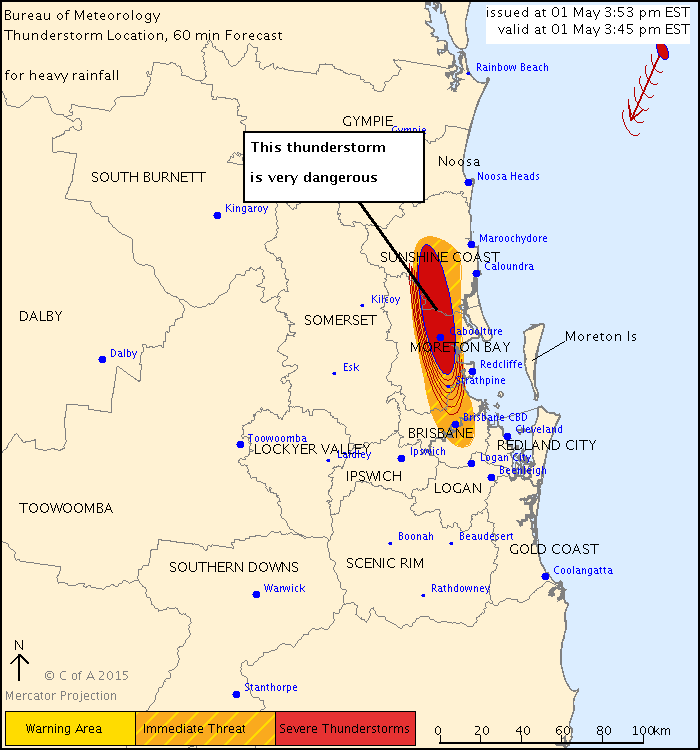
Southeast QLD Severe Thunderstorm Warning: Heavy Rain


Southeast QLD Severe Thunderstorm Warning: Heavy Rain
Source: Bureau of Meteorology

For people in parts of the
Sunshine Coast,
Brisbane City and
Moreton Bay Council Areas.

Issued at 3:53 pm Friday, 1 May 2015.

The Bureau of Meteorology warns that, at 3:45 pm, very dangerous thunderstorms were detected on weather radar near Caboolture, Peachester, Landsborough, Crohamhurst, Maleny and Montville. Very dangerous thunderstorms are forecast to affect Strathpine, Kallangur, Wamuran and Mapleton by 4:15 pm and Aspley, Albany Creek, Brighton, Lake Samsonvale, Beachmere and Palmwoods by 4:45 pm.

Heavy rainfall that may lead to flash flooding. Rainfall totals of more than 100mm per hour have been recored in the area.

Queensland Fire and Emergency Services advises that people should:
* Avoid driving, walking or riding through flood waters.
* Seek shelter, preferably indoors and never under trees.
* Avoid using the telephone during a thunderstorm.
* Beware of fallen trees and powerlines.
* For emergency assistance contact the SES on 132 500.

EWN Radar & Alerts Map | QLD Facebook Alerts | Twitter Alerts

Unsubscribe | EWN Support | Register

Google Alert - "Queensland Scam"

Google
"Queensland Scam"
As-it-happens update ⋅ 1 May 2015
NEWS
Brisbane Times
Scam threatens older residents with tax fraud prosecution
Scammers pretending to be the ATO are calling South Brisbane residents and demanding money via a prepaid Visa. Photo: Jessica Shapiro.
Google Plus Facebook Twitter Flag as irrelevant
You have received this email because you have subscribed to Google Alerts.
RSS Receive this alert as RSS feed
Send Feedback

QLD Severe Weather Warning: Damaging Winds & Heavy Rain


QLD Severe Weather Warning: Damaging Winds & Heavy Rain
Source: Bureau of Meteorology

For people in the
Wide Bay and Burnett,
Southeast Coast and parts of the
Darling Downs and Granite Belt Forecast Districts.

Issued at 11:16 am Friday, 1 May 2015.

Synoptic Situation:

A surface low is expected to deepen near Fraser Island and move southwards along Queensland's south coast during the evening and overnight. The low is supported by a strong upper trough moving across the southern Queensland. The upper trough together with the low will move away from the south coast during Saturday.

Heavy rain, which may lead to flash flooding, is expected over areas of the southeast corner, from about Bundaberg to Dalby to Stanthorpe. Further falls of 50 to 150mm are likely, with isolated falls between 200 to 300mm possible, mainly about the coast and with thunderstorms.

Falls of between 100mm to 200mm have been recorded around the Sunshine Coast region since yesterday.

The heavy rain areas should contract towards the Gold Coast by later tonight and are expected to move off the Gold Coast during Saturday morning.

Damaging winds, with peak gusts of around 90km/h are possible near coastal areas as the low moves southwards later today and tonight.

The low is likely to generate large swells causing dangerous surf about the Fraser Island, Sunshine Coast and Gold Coast beaches. The dangerous surf conditions are likely to produce significant beach erosion for these areas. Water levels could exceed the highest tide of the year by around half a metre during this evening's high tide.

A Flood Watch is current for parts of the Wide Bay and Burnett, Southeast Coast and the Darling Downs and Granite Belt forecast districts.

Locations which may be affected include Gold Coast, Toowoomba, Brisbane, Caboolture, Dalby, Maroochydore, Gympie, Noosa, Hervey Bay, Bundaberg, Kingaroy and Stanthorpe.

The Severe Weather Warning for the Central Highlands and Coalfields has now been cancelled.

Queensland Fire and Emergency Services advises that people should:
* Move your car under cover or away from trees.
* Secure loose outdoor items.
* Seek shelter, preferably indoors and never under trees.
* Beware of fallen trees and powerlines.
* Avoid driving, walking or riding through flood waters.
* Keep clear of creeks and storm drains.
* Surf Life Saving Australia recommends that you stay out of the water and stay well away from surf-exposed areas.
* Check your property regularly for erosion or inundation by sea water, and if necessary raise goods and electrical items.
* For emergency assistance contact the SES on 132 500.

EWN Radar & Alerts Map | QLD Facebook Alerts | Twitter Alerts

Unsubscribe | EWN Support | Register

QLD Severe Weather Warning: Heavy Rain & Damaging Winds


QLD Severe Weather Warning: Heavy Rain & Damaging Winds
Source: Bureau of Meteorology

For people in the
Southeast Coast and parts of the
Wide Bay and Burnett and
Darling Downs and Granite Belt Forecast Districts.

Issued at 11:26 am Thursday, 30 April 2015.

Synoptic Situation:

A strong upper trough will move east into the southeastern interior of Queensland on Friday and then will move off the southern coast during Saturday. A surface trough will deepen near Fraser Island during Friday, with a low pressure system most likely developing and slipping southwards over southern Queensland waters during Friday evening and Saturday morning.

A moist wind flow to the south of the surface trough is expected to combine with the upper feature to generate heavy rain, which may lead to flash flooding, over areas southeast of about Hervey Bay to Dalby to Warwick on Friday. 24 hour totals of 50 to 150mm are likely over inland parts, increasing to 200 to 400mm nearer to the coast with some isolated heavier falls possible.

The heavy rain areas should contract southeast during Friday, gradually clearing the Gold Coast during Saturday morning.

Damaging winds, with peak gusts of around 90km/h are possible from tomorrow afternoon near coastal areas as the surface trough develops offshore.

The low will also most likely generate large swells as it slips southwards during Friday and early Saturday, with dangerous surf developing about Fraser Island, Sunshine Coast and Gold Coast beaches.

Locally heavy falls are also expected today though are more likely to be associated with thunderstorms. Severe thunderstorm warnings will be issued as necessary.

A Flood Watch is current for parts of the Capricornia, Central Highlands and Coalfields, Wide Bay and Burnett, Southeast Coast, Darling Downs and Granite Belt and Maranoa and Warrego forecast districts.

Locations which may be affected include Warwick, Gold Coast, Toowoomba, Brisbane, Dalby, Maroochydore, Gympie, Kingaroy and Hervey Bay waters.

Queensland Fire and Emergency Services advises that people should:
* Move your car under cover or away from trees.
* Secure loose outdoor items.
* Seek shelter, preferably indoors and never under trees.
* Beware of fallen trees and powerlines.
* Avoid driving, walking or riding through flood waters.
* Keep clear of creeks and storm drains.
* Surf Life Saving Australia recommends that you stay out of the water and stay well away from surf-exposed areas.
* Check your property regularly for erosion or inundation by sea water, and if necessary raise goods and electrical items.
* For emergency assistance contact the SES on 132 500.

EWN Radar & Alerts Map | QLD Facebook Alerts | Twitter Alerts

Unsubscribe | EWN Support | Register

SCAMwatch email alert: Immigration scam targets migrants [SEC=UNCLASSIFIED]

The ACCC and the Department of Immigration and Border Protection (DIBP) have been getting reports of scammers claiming to be government officials. The scammers call migrants and temporary visa holders and threaten them with deportation supposedly because of problems with their immigration paperwork or visa status.

 Scammers are demanding up-front fees of around $1,000 to resubmit forms. These scam phone calls appear to be targeting people from India and Pakistan. The ACCC has received 150 reports of this scam since February with more than $35,000 reported lost.

Scammers may try to pressure you by calling repeatedly and harassing you, even threatening to send the police to your house – but if you give your money to a scammer you will never see it again. The DIBP has confirmed that it does not ask for any payment of fines or penalties by telephone.

Be on guard, if you receive a phone call from someone threatening you with deportation and asking you to pay a fee, hang up and do not respond. If in doubt, don't use any contact details provided by the caller - look up the government department or organisation yourself in the phone book or online and phone or email them.

How these scams work

  • You receive a call out of the blue from someone claiming to be from the "Department of Immigration".
  • You may be left a message on your answering machine asking you to ring a number.
  • The caller will claim that you have issues with your immigration forms or visa status.
  • The scammer will tell you that in order to resolve the matter you will need to pay a fee or fine.
  • The caller may try to get information from you like your passport details, date of birth or bank information.
  • The caller may claim the police will come to your door and arrest you if you do not pay the fee or fine immediately.
  • The caller may even offer to send a taxi to your house to take you to the nearest post office to make a payment via wire transfer or other electronic payment method.
  • If you send any money via wire transfer, you will never see it again – it's nearly impossible to recover money sent this way.
  • If you provide any personal information, the scammer may use it to commit identity theft.

Protect yourself

  • If you receive a phone call out of the blue from someone claiming to be from the DIBP telling you that you will be deported unless you pay a fine, hang up.
  • If you have any doubts about the identity of any caller who claims to represent a government department, contact the department directly. Don't rely on numbers, email addresses or websites provided by the caller – find them through an independent source such as a phone book or online search.
  • Never send any money via wire transfer to anyone you do not know or trust.
  • Never give your personal information or bank account details over the phone unless you made the call and the phone number came from a trusted source. If you think you have provided your details to a scammer, contact your bank or financial institution immediately.


Report

You can report immigration fraud matters to the Department of Immigration and Border Protection through their Immigration Dob-In Service.

You can report scams to the ACCC via the SCAMwatch report a scam page or by calling 1300 795 995.

More information


Stay one step ahead of scammers, follow
@SCAMwatch_gov on Twitter.


If you no longer want to receive SCAMwatch email alerts, please unsubscribe on the SCAMwatch website.


SCAMwatch email alert: Telephone calls alleging fake arrest warrants used to scam money [SEC=UNCLASSIFIED]

Telephone calls alleging fake arrest warrants used to scam money


April 2015: SCAMwatch is warning consumers to be aware of calls from scammers falsely claiming to be from the Commonwealth Director of Public Prosecutions (CDPP) or Australian Tax Office (ATO).


Scammers have recently been calling Australians telling them that there is a warrant out for their arrest. Many people have reported to SCAMwatch that messages have been recorded on their answering machines asking them to call back later. The telephone number provided is 0261003027 and they ask you to call during office hours to discuss the matter further. However, the telephone number has no connection with the Commonwealth Director of Public Prosecutions, Australian Taxation Office or any other state or commonwealth department.


The scammers may spin a range of stories about why an arrest warrant has been issued, including that you have failed to pay taxes.

Scammers typically ask for money to be sent via wire transfer as it's nearly impossible to recover money sent this way. They may also ask for people's financial and other personal details to access their money and use this information to commit other scams.


Be on guard, if you receive a phone call from someone saying you have an arrest warrant and asking you to pay a fee, hang up and do not respond. If in doubt, don't use the contact details provided - look up the government department or organisation yourself in the phone book or online and phone or email them.

How these scams work

You receive a call out of the blue from someone claiming to be from the Commonwealth Director of Public Prosecutions or the Australian Taxation Office.

The call may sound like it is an automated message with an American accent.

The caller or sender will claim that you have an arrest warrant for some reason.

The scammer will ask you to telephone a number that appears to be Australian but is likely to be a VOIP number.

The number reported is 02 6100 3027. This is not the correct number for the CDPP.

The scammer will tell you that in order to resolve the matter you will need to pay a fee.

You may also be asked to provide your bank account details or other personal information so they can confirm they have the right person.

If you send any money via wire transfer, you will never see it again – it's nearly impossible to recover money sent this way. You will also never receive the promised rebate or refund.

If you provide your bank account details or other personal information, the scammer may use it to commit identity theft or to steal your money.

Protect yourself

If you receive a phone call or email out of the blue from someone claiming to be from the Commonwealth Department of Public Prosecutions or Australian Taxation Office telling you about an arrest warrant, hang up.

If you receive a message on your phone asking you to telephone 02 6100 3027, delete the message.

If you have any doubts about the identity of any caller who claims to represent a government department, contact the body directly. Don't rely on numbers, email addresses or websites provided by the caller – find them through an independent source such as a phone book or online search.

The CDPP is advising people to be vigilant when receiving phone calls of this nature and if in doubt about the authenticity of a call that you receive from the CDPP, contact them on one of the publically listed phone numbers or email inquiries@cdpp.gov.au.

Never send any money via wire transfer to anyone you do not know or trust.

Never give your personal, credit card or online account details over the phone unless you made the call and the phone number came from a trusted source. If you think you have provided your account details to a scammer, contact your bank or financial institution immediately.

Report

You can report scams to the ACCC via the SCAMwatch report a scam page or by calling 1300 795 995.

More information

See advice at the Commonwealth Director of Public Prosecutions website.


Stay one step ahead of scammers, follow @SCAMwatch_gov on Twitter.  

You have received this email because you have subscribed to receive SCAMwatch radar alerts on scams targeting Australians. These alerts are issued by the Australian Competition and Consumer Commission and can be viewed on its SCAMwatch website http://www.scamwatch.gov.au.

If you have any doubts about an email's source, verify the sender by independent means - use their official contact details to check the email is legitimate before clicking on links or opening attachments.

If you no longer want to receive SCAMwatch email alerts, please unsubscribe on the SCAMwatch website.

SCAMwatch email alert: Telephone calls alleging fake arrest warrants used to scam money [SEC=UNCLASSIFIED]


Telephone calls alleging fake arrest warrants used to scam money


April 2015: SCAMwatch is warning consumers to be aware of calls from scammers falsely claiming to be from the Commonwealth Director of Public Prosecutions (CDPP) or Australian Tax Office (ATO).

Scammers have recently been calling Australians telling them that there is a warrant out for their arrest. Many people have reported to SCAMwatch that messages have been recorded on their answering machines asking them to call back later. The telephone number provided is 0261003027 and they ask you to call during office hours to discuss the matter further. However, the telephone number has no connection with the Commonwealth Director of Public Prosecutions, Australian Taxation Office or any other state or commonwealth department.

The scammers may spin a range of stories about why an arrest warrant has been issued, including that you have failed to pay taxes.

Scammers typically ask for money to be sent via wire transfer as it's nearly impossible to recover money sent this way. They may also ask for people's financial and other personal details to access their money and use this information to commit other scams.

Be on guard, if you receive a phone call from someone saying you have an arrest warrant and asking you to pay a fee, hang up and do not respond. If in doubt, don't use the contact details provided - look up the government department or organisation yourself in the phone book or online and phone or email them.

How these scams work

You receive a call out of the blue from someone claiming to be from the Commonwealth Director of Public Prosecutions or the Australian Taxation Office.


  • The call may sound like it is an automated message with an American accent.
  • The caller or sender will claim that you have an arrest warrant for some reason.
  • The scammer will ask you to telephone a number that appears to be Australian but is likely to be a VOIP number.
  • The number reported is 02 6100 3027. This is not the correct number for the CDPP.
  • The scammer will tell you that in order to resolve the matter you will need to pay a fee.
  • You may also be asked to provide your bank account details or other personal information so they can confirm they have the right person.
  • If you send any money via wire transfer, you will never see it again – it's nearly impossible to recover money sent this way. You will also never receive the promised rebate or refund.
  • If you provide your bank account details or other personal information, the scammer may use it to commit identity theft or to steal your money.

Protect yourself

  • If you receive a phone call or email out of the blue from someone claiming to be from the Commonwealth Department of Public Prosecutions or Australian Taxation Office telling you about an arrest warrant, hang up.
  • If you receive a message on your phone asking you to telephone 02 6100 3027, delete the message.
  • If you have any doubts about the identity of any caller who claims to represent a government department, contact the body directly. Don't rely on numbers, email addresses or websites provided by the caller – find them through an independent source such as a phone book or online search.
  • The CDPP is advising people to be vigilant when receiving phone calls of this nature and if in doubt about the authenticity of a call that you receive from the CDPP, contact them on one of the publically listed phone numbers or email inquiries@cdpp.gov.au.
  • Never send any money via wire transfer to anyone you do not know or trust.
  • Never give your personal, credit card or online account details over the phone unless you made the call and the phone number came from a trusted source. If you think you have provided your account details to a scammer, contact your bank or financial institution immediately.

Report

You can report scams to the ACCC via the SCAMwatch report a scam page or by calling 1300 795 995.

More information

See advice at the Commonwealth Director of Public Prosecutions website.


Stay one step ahead of scammers, follow @SCAMwatch_gov on Twitter.  


SCAMwatch email alert: Telephone calls alleging fake arrest warrants used to scam money [SEC=UNCLASSIFIED]


Telephone calls alleging fake arrest warrants used to scam money


April 2015: SCAMwatch is warning consumers to be aware of calls from scammers falsely claiming to be from the Commonwealth Director of Public Prosecutions (CDPP) or Australian Tax Office (ATO).

Scammers have recently been calling Australians telling them that there is a warrant out for their arrest. Many people have reported to SCAMwatch that messages have been recorded on their answering machines asking them to call back later. The telephone number provided is 0261003027 and they ask you to call during office hours to discuss the matter further. However, the telephone number has no connection with the Commonwealth Director of Public Prosecutions, Australian Taxation Office or any other state or commonwealth department.

The scammers may spin a range of stories about why an arrest warrant has been issued, including that you have failed to pay taxes.

Scammers typically ask for money to be sent via wire transfer as it's nearly impossible to recover money sent this way. They may also ask for people's financial and other personal details to access their money and use this information to commit other scams.

Be on guard, if you receive a phone call from someone saying you have an arrest warrant and asking you to pay a fee, hang up and do not respond. If in doubt, don't use the contact details provided - look up the government department or organisation yourself in the phone book or online and phone or email them.

How these scams work

You receive a call out of the blue from someone claiming to be from the Commonwealth Director of Public Prosecutions or the Australian Taxation Office.


  • The call may sound like it is an automated message with an American accent.
  • The caller or sender will claim that you have an arrest warrant for some reason.
  • The scammer will ask you to telephone a number that appears to be Australian but is likely to be a VOIP number.
  • The number reported is 02 6100 3027. This is not the correct number for the CDPP.
  • The scammer will tell you that in order to resolve the matter you will need to pay a fee.
  • You may also be asked to provide your bank account details or other personal information so they can confirm they have the right person.
  • If you send any money via wire transfer, you will never see it again – it's nearly impossible to recover money sent this way. You will also never receive the promised rebate or refund.
  • If you provide your bank account details or other personal information, the scammer may use it to commit identity theft or to steal your money.

Protect yourself

  • If you receive a phone call or email out of the blue from someone claiming to be from the Commonwealth Department of Public Prosecutions or Australian Taxation Office telling you about an arrest warrant, hang up.
  • If you receive a message on your phone asking you to telephone 02 6100 3027, delete the message.
  • If you have any doubts about the identity of any caller who claims to represent a government department, contact the body directly. Don't rely on numbers, email addresses or websites provided by the caller – find them through an independent source such as a phone book or online search.
  • The CDPP is advising people to be vigilant when receiving phone calls of this nature and if in doubt about the authenticity of a call that you receive from the CDPP, contact them on one of the publically listed phone numbers or email inquiries@cdpp.gov.au.
  • Never send any money via wire transfer to anyone you do not know or trust.
  • Never give your personal, credit card or online account details over the phone unless you made the call and the phone number came from a trusted source. If you think you have provided your account details to a scammer, contact your bank or financial institution immediately.

Report

You can report scams to the ACCC via the SCAMwatch report a scam page or by calling 1300 795 995.

More information

See advice at the Commonwealth Director of Public Prosecutions website.


Stay one step ahead of scammers, follow @SCAMwatch_gov on Twitter.